

NCCS’ Primary Computing Platform
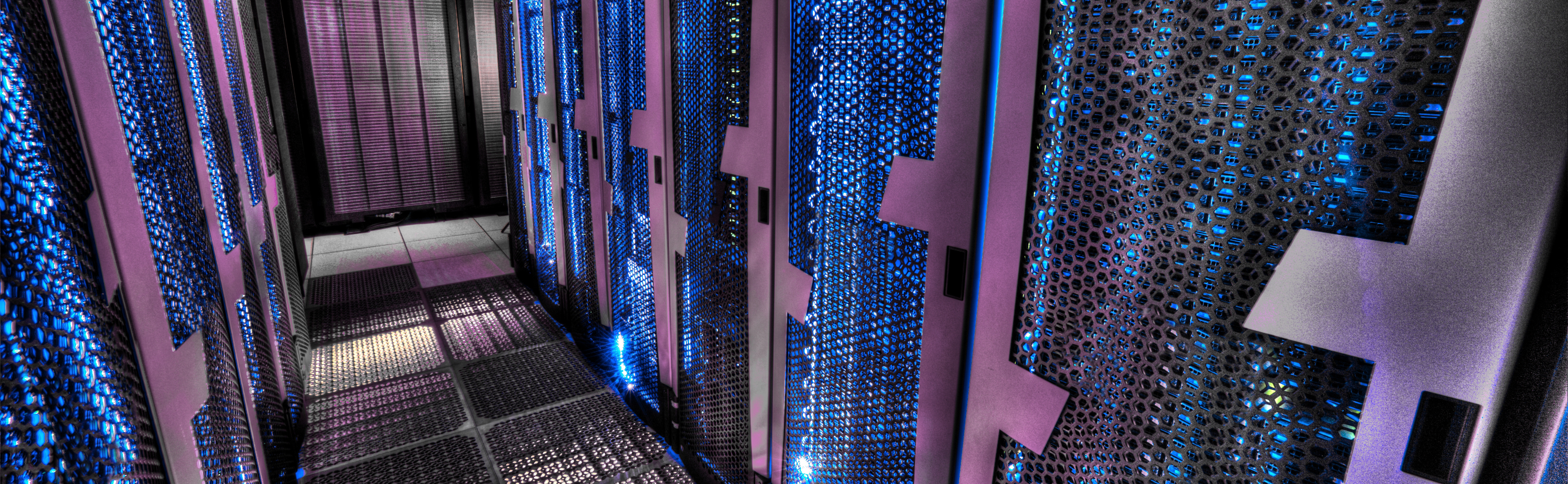
The centerpiece of the NCCS is the 213,288-core “Discover” supercomputing cluster, an assembly of multiple Linux scalable units built upon commodity components capable of 8.28 petaflops, or 8,280 trillion floating-point operations per second.
Discover is particularly suited for large, complex, communications-intensive problems employing large matrices and science applications, which benefit from its ecosystem of system software and tools. Example applications include fine-scale, high-fidelity simulations of the atmosphere and oceans that span time scales from days (weather prediction), to seasons and years (short-term climate prediction), to decades and centuries (climate change projection).
Discover derives its name from the NASA adage of “Explore. Discover. Understand.” The NCCS installed the first scalable unit in the fall of 2006 and continues to expand this highly successful computing platform.

System Specifications
Aggregate
8.28 Pflop/s
213,288 Total Cores
File System
IBM GPFS
49.5 PB Disk
Operating Environment
Operating System: SLES
Job Scheduler: Slurm
Compilers: C, C++, Fortran
(Intel and PGI)
Analysis applications
include IDL, Matlab, and more
Using Discover
Everything you need to know about how to work with Discover:
- Best practices
- Tools
- Resource Manager (SLURM)
- Software
- User FAQ’s
- Instructionals
Fun Facts
Performance
Discover’s over 213,000 cores perform nearly 8.28 quadrillion calculations per second
Storage
Enough disk to store 40 million movies
Power
Runs on 2 megawatts of power – electricity to power +/- 1,400 homes
Time-Lapse Installation
SCU14 Time-lapse Installation #1
SCU14 Time-lapse Installation #2
Each project’s computational requirements are unique. Explore our case studies to see how the NCCS is innovating tailor-made solutions for NASA projects.
Account Information
See information about account eligibility, set-up, and maintenance.